Pardoned Criminals That Committed Crimes Again.
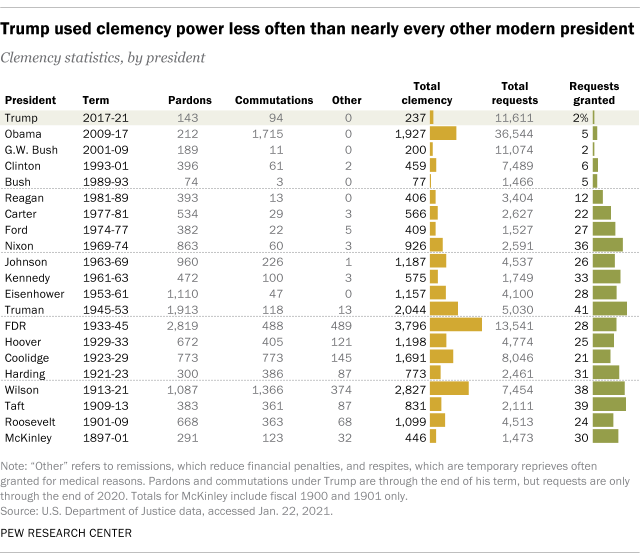
Despite a flare-up of pardons and commutations in his terminal hours in office, Donald Trump used his executive charity power less frequently than nearly every other president since the turn of the 20th century, according to a Pew Research Center analysis of U.S. Justice Department data.
Trump granted 237 acts of clemency during his four years in the White House, including 143 pardons and 94 commutations. Only 2 other presidents since 1900 – George Due west. and George H.W. Bush – granted fewer acts of charity than Trump.
His predecessor, Barack Obama, granted clemency 1,927 times over the course of eight years in office, the highest total of any president going dorsum to Harry Truman. Obama's total was skewed heavily toward commutations (1,715) instead of pardons (212).
Donald Trump concluded his presidency with a wave of pardons and commutations for those convicted or accused of federal crimes. This analysis examines how Trump compares with other mod presidents in his overall use of executive clemency.
All findings in this analysis are based on data from the U.S. Justice Department, accessed Jan. 22, 2021. Pardons and commutations under Trump are through the terminate of his term, simply requests are only through Dec 2020. The number of requests Trump received could be higher than reported here considering of boosted requests he may accept received in January 2021.
All pardons and commutations issued by Trump are counted equally requests granted, even in cases when recipients did not formally petition for clemency.
Looking at the same information another way, Trump granted clemency to just 2% of the eleven,611 people who petitioned him for it. Only George W. Bush granted clemency to a similarly small proportion of applicants (two%). Trump'south final percentage all the same could end up beingness the lowest on record because the Justice Department has not withal published data on the number of applications he received in Jan 2021, during his terminal iii weeks in part.
Charity refers to multiple forms of presidential mercy. The two near common forms are pardons, which forgive past crimes and restore ceremonious rights, and commutations, which completely or partially reduce sentences for those in prison or on community supervision. Two less-common forms are remissions, which reduce financial penalties associated with convictions, and respites, which are temporary reprieves that are normally granted to inmates for medical reasons.
The Justice Department's statistics do not count clemency granted through proclamation or executive guild, such equally the actions taken by Presidents Gerald Ford and Jimmy Carter to forgive thousands of Vietnam-era draft dodgers.
While rare overall, Trump's use of presidential clemency acquired controversy because of the nature of his pardons and commutations. Many of Trump's clemency recipients had a "personal or political connection to the president," and he frequently circumvented the formal procedure through which clemency requests are typically considered, according to analyses by the Lawfare weblog.
Trump was far from the only president to confront scrutiny over his employ of charity. Obama's frequent employ of commutations, particularly for prisoners bedevilled of drug-related crimes, prompted criticism from Republicans, who said it benefited "an entire class of offenders" and infringed on the "lawmaking authority" of the legislative branch. And President Bill Clinton drew bipartisan condemnation for pardoning a avoiding bolt trader, Marc Rich, on his last day in part in 2001.
Trump likewise wasn't the just president to relieve many of his pardons and commutations for his last hours on the job. In fact, every president from Ford to Trump issued pardons or commutations in his last days in the White Business firm, according to the Justice Department. Obama, for example, granted 330 acts of charity on January. 19, 2017, and Clinton granted 177 on Jan. 20, 2001.
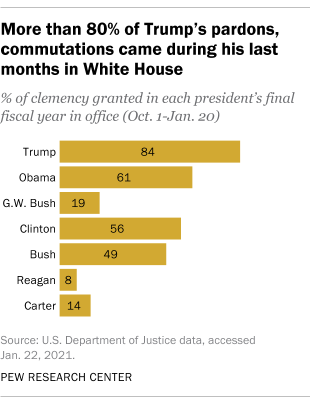
Trump, nonetheless, still granted an unusually big percent of pardons and commutations late in his term. More eight-in-ten of his total acts of charity (84%) came in his final fiscal year in role (the period between October. 1 and Jan. 20). That was far college than the share for other recent presidents, including Obama (61%), Clinton (56%) and George H.West. Bush (49%).
Presidents have generally go less forgiving over time, at least when looking at the proportion of clemency requests they accept granted. Every president from William McKinley to Carter granted clemency to at least twenty% of those who asked for it, according to the Justice Department information. Merely the percentages have fallen to the single digits for every president since George H.West. Bush, including Obama, who granted charity to just 5% of those who petitioned him for it.
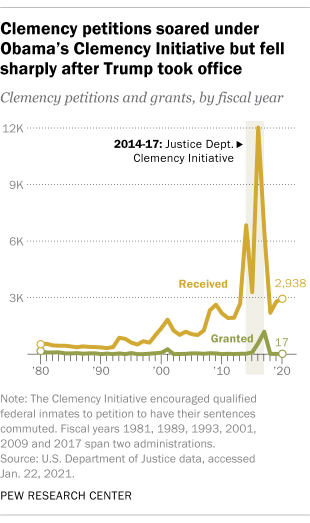
Obama's relatively low percentage was largely due to the fact that his administration encouraged federal prisoners to apply for leniency under a program known as the Clemency Initiative. The program, which launched in Apr 2014 and concluded when Obama left office in 2017, allowed "qualified federal inmates" – those who met certain Justice Section criteria – to utilise to have their prison sentences commuted.
Overall, Obama received more than 36,000 clemency petitions during his fourth dimension in office, by far the largest total of whatever president on record. Petitions declined sharply afterward Trump took office.
Note: This is an update of a post originally published on Dec. ix, 2016, and previously updated on Nov. 24, 2020.
Source: https://www.pewresearch.org/fact-tank/2021/01/22/trump-used-his-clemency-power-sparingly-despite-a-raft-of-late-pardons-and-commutations/

Enviar um comentário for "Pardoned Criminals That Committed Crimes Again."